Brand Name
Aciphex
Generic Name
Rabeprazole
View Brand Information FDA approval date: November 08, 2013
Classification: Proton Pump Inhibitor
Form: Tablet
What is Aciphex (Rabeprazole)?
Rabeprazole Sodium Delayed-Release Tablets is a proton pump inhibitor indicated in adults for: Healing of Erosive or Ulcerative Gastroesophageal Reflux Disease
Approved To Treat
Top Global Experts
There are no experts for this drug
Save this treatment for later
Not sure about your diagnosis?
Tired of the same old research?
Related Clinical Trials
There is no clinical trials being done for this treatment
Related Latest Advances
There is no latest advances for this treatment
Brand Information
Aciphex (rabeprazole sodium)
1DOSAGE AND ADMINISTRATION
Table 1 shows the recommended dosage of ACIPHEX delayed-release tablets in adults and adolescent patients 12 years of age and older. The use of ACIPHEX delayed-release tablets is not recommended for use in pediatric patients 1 year to less than 12 years of age because the lowest available tablet strength (20 mg) exceeds the recommended dose for these patients. Use another rabeprazole formulation for pediatric patients 1 year to less than 12 years of age.
Administration Instructions
- Swallow ACIPHEX delayed-release tablets whole. Do not chew, crush, or split tablets.
- For the treatment of duodenal ulcers take ACIPHEX delayed-release tablets after a meal.
- For
- For all other indications ACIPHEX delayed-release tablets can be taken with or without food.
- Take a missed dose as soon as possible. If it is almost time for the next dose, skip the missed dose and go back to the normal schedule. Do not take two doses at the same time.
2DOSAGE FORMS AND STRENGTHS
ACIPHEX delayed-release tablets are provided in one strength, 20 mg. The tablets are round, light yellow, enteric coated, biconvex tablets. "ACIPHEX 20" is imprinted in red on one side of the tablet.
3CONTRAINDICATIONS
- ACIPHEX is contraindicated in patients with known hypersensitivity to rabeprazole, substituted benzimidazoles, or to any component of the formulation. Hypersensitivity reactions may include anaphylaxis, anaphylactic shock, angioedema, bronchospasm, acute tubulointerstitial nephritis, and urticaria
- PPIs, including ACIPHEX, are contraindicated with rilpivirine-containing products
- For information about contraindications of antibacterial agents (clarithromycin and amoxicillin) indicated in combination with ACIPHEX delayed-release tablets, refer to the
4ADVERSE REACTIONS
The following serious adverse reactions are described below and elsewhere in labeling:
- Acute Tubulointerstitial Nephritis
- Clostridium difficile-Associated Diarrhea [see
- Bone Fracture
- Cutaneous and Systemic Lupus Erythematosus
- Cyanocobalamin (Vitamin B-12) Deficiency
- Hypomagnesemia and Mineral Metabolism
- Fundic Gland Polyps
4.1Clinical Studies Experience
Because clinical trials are conducted under varying conditions, adverse reaction rates observed in the clinical trials of a drug cannot be directly compared to rates in the clinical trials of another drug and may not reflect the rates observed in practice.
Adults
The data described below reflect exposure to ACIPHEX delayed-release tablets in 1064 adult patients exposed for up to 8 weeks. The studies were primarily placebo- and active-controlled trials in adult patients with Erosive or Ulcerative Gastroesophageal Reflux Disease (GERD), Duodenal Ulcers and Gastric Ulcers. The population had a mean age of 53 years (range 18-89 years) and had a ratio of approximately 60% male: 40% female. The racial distribution was 86% Caucasian, 8% African American, 2% Asian, and 5% other. Most patients received either 10 mg, 20 mg or 40 mg per day of ACIPHEX delayed-release tablets.
An analysis of adverse reactions appearing in ≥2% of patients treated with ACIPHEX delayed-release tablets (n=1064) and with a greater frequency than placebo (n=89) in controlled North American and European acute treatment trials, revealed the following adverse reactions: pain (3% vs. 1%), pharyngitis (3% vs. 2%), flatulence (3% vs. 1%), infection (2% vs. 1%), and constipation (2% vs. 1%).
Three long-term maintenance studies consisted of a total of 740 adult patients; at least 54% of adult patients were exposed to ACIPHEX delayed-release tablets for 6 months and at least 33% were exposed for 12 months. Of the 740 adult patients, 247 (33%) and 241 (33%) patients received 10 mg and 20 mg of ACIPHEX delayed-release tablets, respectively, while 169 (23%) patients received placebo and 83 (11%) received omeprazole.
The safety profile of rabeprazole in the maintenance studies in adults was consistent with what was observed in the acute studies.
Less common adverse reactions seen in controlled clinical trials (<2% of patients treated with ACIPHEX delayed-release tablets and greater than placebo) and for which there is a possibility of a causal relationship to rabeprazole, include the following: headache, abdominal pain, diarrhea, dry mouth, dizziness, peripheral edema, hepatic enzyme increase, hepatitis, hepatic encephalopathy, myalgia, and arthralgia.
Combination Treatment with Amoxicillin and Clarithromycin: In clinical trials using combination therapy with rabeprazole plus amoxicillin and clarithromycin (RAC), no adverse reactions unique to this drug combination were observed. In the U.S. multicenter study, the most frequently reported drug related adverse reactions for patients who received RAC therapy for 7 or 10 days were diarrhea (8% and 7%) and taste perversion (6% and 10%), respectively.
No clinically significant laboratory abnormalities particular to the drug combinations were observed.
For more information on adverse reactions or laboratory changes with amoxicillin or clarithromycin, refer to their respective prescribing information,
Pediatrics
In a multicenter, open-label study of adolescent patients 12 to 16 years of age with a clinical diagnosis of symptomatic GERD or endoscopically proven GERD, the adverse event profile was similar to that of adults. The adverse reactions reported without regard to relationship to ACIPHEX delayed-release tablets that occurred in ≥2% of 111 patients were headache (9.9%), diarrhea (4.5%), nausea (4.5%), vomiting (3.6%), and abdominal pain (3.6%). The related reported adverse reactions that occurred in ≥2% of patients were headache (5.4%) and nausea (1.8%). There were no adverse reactions reported in this study that were not previously observed in adults.
4.2Postmarketing Experience
The following adverse reactions have been identified during post approval use of rabeprazole. Because these reactions are reported voluntarily from a population of uncertain size, it is not always possible to reliably estimate their frequency or establish a causal relationship to drug exposure:
Blood and Lymphatic System Disorders: agranulocytosis, hemolytic anemia, leukopenia, pancytopenia, thrombocytopenia
Ear and Labyrinth Disorders: vertigo
Eye Disorders: blurred vision
Gastrointestinal Disorders: fundic gland polyps
General Disorders and Administration Site Conditions: sudden death
Hepatobiliary Disorders: jaundice
Immune System Disorders: anaphylaxis, angioedema, systemic lupus erythematosus, Stevens-Johnson syndrome, toxic epidermal necrolysis (some fatal), DRESS, AGEP
Infections and Infestations: Clostridium difficile-associated diarrhea
Investigations: Increases in prothrombin time/INR (in patients treated with concomitant warfarin), TSH elevations
Metabolism and Nutrition Disorders: hyperammonemia, hypomagnesemia, hypocalcemia, hypokalemia [Warnings and Precautions 5.8], hyponatremia
Musculoskeletal System Disorders: bone fracture, rhabdomyolysis
Nervous System Disorders: coma
Psychiatric Disorders: delirium, disorientation
Renal and Genitourinary Disorders: interstitial nephritis, erectile dysfunction
Respiratory, Thoracic and Mediastinal Disorders: interstitial pneumonia
Skin and Subcutaneous Tissue Disorders: severe dermatologic reactions including bullous and other drug eruptions of the skin, cutaneous lupus erythematosus, erythema multiforme
5DRUG INTERACTIONS
Table 2 includes drugs with clinically important drug interactions and interaction with diagnostics when administered concomitantly with ACIPHEX delayed-release tablets and instructions for preventing or managing them.
Consult the labeling of concomitantly used drugs to obtain further information about interactions with PPIs.
6OVERDOSAGE
Seven reports of accidental overdosage with rabeprazole have been received. The maximum reported overdose was 80 mg. There were no clinical signs or symptoms associated with any reported overdose. Patients with Zollinger-Ellison syndrome have been treated with up to 120 mg rabeprazole once daily. No specific antidote for rabeprazole is known. Rabeprazole is extensively protein bound and is not readily dialyzable.
In the event of overdosage, treatment should be symptomatic and supportive.
If over-exposure occurs, call your Poison Control Center at 1-800-222-1222 for current information on the management of poisoning or overdosage.
7DESCRIPTION
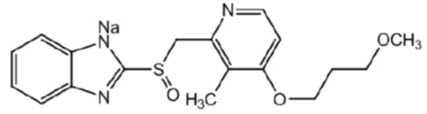
The active ingredient in ACIPHEX delayed-release tablets is rabeprazole sodium, which is a proton pump inhibitor. It is a substituted benzimidazole known chemically as 2-[[[4-(3-methoxypropoxy)-3-methyl-2-pyridinyl]-methyl]sulfinyl]-1
Figure 1
ACIPHEX is available for oral administration as delayed-release, enteric-coated tablets containing 20 mg of rabeprazole sodium.
Inactive ingredients of the 20 mg tablet are carnauba wax, crospovidone, diacetylated monoglycerides, ethylcellulose, hydroxypropyl cellulose, hypromellose phthalate, magnesium stearate, mannitol, sodium hydroxide, sodium stearyl fumarate, talc, and titanium dioxide. Iron oxide yellow is the coloring agent for the tablet coating. Iron oxide red is the ink pigment.
8REFERENCES
1. Clinical and Laboratory Standards Institute (CLSI).
9HOW SUPPLIED/STORAGE AND HANDLING
ACIPHEX 20 mg is supplied as delayed-release light yellow enteric-coated tablets. The name and strength, in mg, (ACIPHEX 20) is imprinted on one side.
Bottles of 30 (NDC 80725-243-30)
10PATIENT COUNSELING INFORMATION
Advise the patient to read the FDA-approved patient labeling (Medication Guide).
Acute Tubulointerstitial Nephritis
Advise the patient or caregiver to call the patient's healthcare provider immediately if they experience signs and/or symptoms associated with -acute tubulointerstitial nephritis
Clostridium difficile-Associated Diarrhea
Advise the patient or caregiver to immediately call the patient's healthcare provider if they experience diarrhea that does not improve
Bone Fracture
Advise the patient or caregiver to report any fractures, especially of the hip, wrist or spine, to the patient's healthcare provider
Severe Cutaneous Adverse Reactions
Advise the patient or caregiver to discontinue ACIPHEX and report any signs and symptoms of a severe cutaneous adverse reaction or other sign of hypersensitivity to the healthcare provider
Cutaneous and Systemic Lupus Erythematosus
Advise the patient or caregiver to immediately call the patient's healthcare provider for any new or worsening of symptoms associated with cutaneous or systemic lupus erythematosus
Cyanocobalamin (Vitamin B-12) Deficiency
Advise the patient or caregiver to report any clinical symptoms that may be associated with cyanocobalamin deficiency to the patient's healthcare provider if they have been receiving ACIPHEX for longer than 3 years
Hypomagnesemia and Mineral Metabolism
Advise the patient or caregiver to report any clinical symptoms that may be associated with hypomagnesemia, hypocalcemia, hypokalemia and hyponatremia to the patient's healthcare provider, if they have been receiving ACIPHEX for at least 3 months
Drug Interactions
Advise patients to report to their healthcare provider if they are taking rilpivirine-containing products
Administration
- Swallow ACIPHEX delayed-release tablets whole. Do not chew, crush or split the tablets.
- For the treatment of duodenal ulcers take ACIPHEX delayed-release tablets after a meal.
- For
- For all other indications ACIPHEX delayed-release tablets can be taken with or without food.
- Take a missed dose as soon as possible. If it is almost time for the next dose, skip the missed dose and go back to the normal schedule. Do not take two doses at the same time.
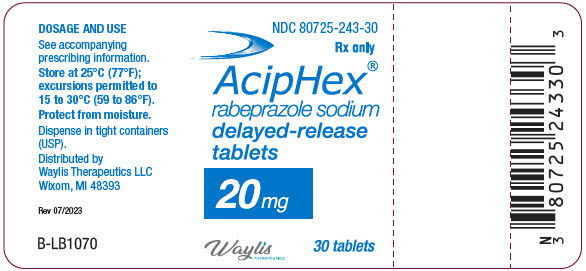
11PRINCIPAL DISPLAY PANEL - 20 mg Tablet Bottle Label
NDC 80725-243-30
Rx only
AcipHex
20 mg
Waylis
30 tablets