Generic Name

Alendronate

Brand Names
Fosamax, Binosto
FDA approval date: February 06, 2008
Classification: Bisphosphonate
Form: Tablet, Solution

What is Fosamax (Alendronate)?

Alendronate sodium tablets are a bisphosphonate indicated for: Treatment and prevention of osteoporosis in postmenopausal women.
Save this treatment for later
Sign Up
Not sure about your diagnosis?
Check Your Symptoms
Tired of the same old research?
Check Latest Advances

Related Clinical Trials

The Bone, Exercise, Alendronate, and Caloric Restriction Trial

Summary: The purpose of this research is to identify strategies that minimize bone loss that occurs when older adults lose weight. Participation in this research will involve up to nine assessment visits and last up to two years.

Synergic Role of Vitamin k, D-chiro Inositol and α-lactalbumin in Bone Homeostasis in Breast Cancer Patients Treated With Aromatase Inhibitors

Summary: In women with breast cancer undergoing adjuvant hormone therapy, the marked tissue hypoestrogenism induced by therapy with aromatase inhibitors and/or tamoxifen ± GnRH analogues causes a significant acceleration in bone mass loss, with a consequent increased risk of fracture from the first year of therapy. It is therefore essential to start treatment with antiresorptive drugs and calcium and vitam...

Determination of Selective Bone Turnover Markers and Their Association With Treatment Efficacy in Primary Postmenopausal Osteoporotic Women: A Randomized Control Trial

Summary: This study investigates the use of blood tests known as Bone Turnover Markers (BTMs) to quickly monitor the effectiveness of osteoporosis treatment in postmenopausal women. Osteoporosis, which weakens bones and increases fracture risk, is typically monitored using a DEXA scan to measure bone density (BMD), but this method changes slowly. BTMs may show a response to medication within just 3 to 6 mo...

Brand Information

    FOSAMAX PLUS D (ALENDRONATE SODIUM and CHOLECALCIFEROL)
    1DOSAGE FORMS AND STRENGTHS
    • 70 mg/2800 international units tablets are white to off-white, modified capsule-shaped tablets with code 710 on one side and an outline of a bone image on the other.
    • 70 mg/5600 international units tablets are white to off-white, modified rectangle-shaped tablets with code 270 on one side and an outline of a bone image on the other.
    2CONTRAINDICATIONS
    FOSAMAX PLUS D is contraindicated in patients with the following conditions:
    • Abnormalities of the esophagus which delay esophageal emptying such as stricture or achalasia
    • Inability to stand or sit upright for at least 30 minutes
    • Hypocalcemia
    • Hypersensitivity to any component of this product. Hypersensitivity reactions including urticaria and angioedema have been reported
    3ADVERSE REACTIONS
    The following clinically significant adverse drug reactions are described elsewhere in the labeling:
    • Upper Gastrointestinal Adverse Reactions
    • Mineral Metabolism
    • Musculoskeletal Pain
    • Osteonecrosis of the Jaw
    • Atypical Fractures Including Femoral Fractures
    • Renal Impairment
    3.1Clinical Trials Experience
    Because clinical trials are conducted under widely varying conditions, adverse reaction rates observed in the clinical trials of a drug cannot be directly compared to rates in the clinical trials of another drug and may not reflect the rates observed in clinical practice.
    FOSAMAX
    Treatment of Osteoporosis in Postmenopausal Women
    FOSAMAX Daily
    The safety of FOSAMAX in the treatment of postmenopausal osteoporosis was assessed in four clinical trials that enrolled 7453 women aged 44-84 years. Study 1 and Study 2 were identically designed, three-year, placebo-controlled, double-blind, multicenter studies (United States and Multinational; n=994); Study 3 was the three-year vertebral fracture cohort of the Fracture Intervention Trial [FIT] (n=2027); and Study 4 was the four-year clinical fracture cohort of FIT (n=4432). Overall, 3620 patients were exposed to placebo and 3432 patients exposed to FOSAMAX. Patients with pre-existing gastrointestinal disease and concomitant use of non-steroidal anti-inflammatory drugs were included in these clinical trials. In Study 1 and Study 2 all women received 500 mg elemental calcium as carbonate. In Study 3 and Study 4 all women with dietary calcium intake less than 1000 mg per day received 500 mg calcium and 250 international units Vitamin D per day.
    Among patients treated with alendronate 10 mg or placebo in Study 1 and Study 2, and all patients in Study 3 and Study 4, the incidence of all-cause mortality was 1.8% in the placebo group and 1.8% in the FOSAMAX group. The incidence of serious adverse event was 30.7% in the placebo group and 30.9% in the FOSAMAX group. The percentage of patients who discontinued the study due to any clinical adverse event was 9.5% in the placebo group and 8.9% in the FOSAMAX group. Adverse reactions from these studies considered by the investigators as possibly, probably, or definitely drug related in greater than or equal to 1% of patients treated with either FOSAMAX or placebo are presented in Table 1.
    Rash and erythema have occurred.
    Gastrointestinal Adverse Reactions: One patient treated with FOSAMAX (10 mg/day), who had a history of peptic ulcer disease and gastrectomy and who was taking concomitant aspirin, developed an anastomotic ulcer with mild hemorrhage, which was considered drug related. Aspirin and FOSAMAX were discontinued and the patient recovered. In the Study 1 and Study 2 populations, 49-54% had a history of gastrointestinal disorders at baseline, and 54-89% used nonsteroidal anti-inflammatory drugs or aspirin at some time during the studies. [See
    Laboratory Test Findings: In double-blind, multicenter, controlled studies, asymptomatic, mild, and transient decreases in serum calcium and phosphate were observed in approximately 18% and 10%, respectively, of patients taking FOSAMAX versus approximately 12% and 3% of those taking placebo. However, the incidences of decreases in serum calcium to less than 8.0 mg/dL (2.0 mM) and serum phosphate to less than or equal to 2.0 mg/dL (0.65 mM) were similar in both treatment groups.
    FOSAMAX Once-Weekly
    The safety of FOSAMAX 70 mg once weekly for the treatment of postmenopausal osteoporosis was assessed in a one-year, double-blind, multicenter study comparing FOSAMAX 70 mg once weekly and FOSAMAX 10 mg daily. The overall safety and tolerability profiles of once weekly FOSAMAX 70 mg and FOSAMAX 10 mg daily were similar. The adverse reactions considered by the investigators as possibly, probably, or definitely drug related in greater than or equal to 1% of patients in either treatment group are presented in Table 2.
    Concomitant Use With Estrogen/Hormone Replacement Therapy
    In two studies (of one and two years' duration) of postmenopausal osteoporotic women (total: n=853), the safety and tolerability profile of combined treatment with FOSAMAX 10 mg once daily and estrogen ± progestin (n=354) was consistent with those of the individual treatments.
    Osteoporosis in Men
    In two placebo-controlled, double-blind, multicenter studies in men (a two-year study of FOSAMAX 10 mg/day and a one-year study of once weekly FOSAMAX 70 mg) the rates of discontinuation of therapy due to any clinical adverse event were 2.7% for FOSAMAX 10 mg/day vs. 10.5% for placebo, and 6.4% for once weekly FOSAMAX 70 mg vs. 8.6% for placebo. The adverse reactions considered by the investigators as possibly, probably, or definitely drug related in greater than or equal to 2% of patients treated with either FOSAMAX or placebo are presented in Table 3.
    FOSAMAX PLUS D
    In a fifteen-week double-blind, multinational study in osteoporotic postmenopausal women (n=682) and men (n=35), the safety profile of FOSAMAX PLUS D (70 mg/2800 international units) was similar to that of FOSAMAX once weekly 70 mg. In the 24-week double-blind extension study in women (n=619) and men (n=33), the safety profile of FOSAMAX PLUS D (70 mg/2800 international units) administered with an additional 2800 international units vitamin D
    3.2Post-Marketing Experience
    The following adverse reactions have been identified during post-approval use of FOSAMAX, FOSAMAX PLUS D, or bisphosphonate products. Because these reactions are reported voluntarily from a population of uncertain size, it is not always possible to reliably estimate their frequency or establish a causal relationship to drug exposure.
    Body as a Whole: hypersensitivity reactions including urticaria and angioedema. Transient symptoms of myalgia, malaise, asthenia and rarely, fever have been reported with alendronate, typically in association with initiation of treatment. Symptomatic hypocalcemia has occurred, generally in association with predisposing conditions. Peripheral edema.
    Gastrointestinal: esophagitis, esophageal erosions, esophageal ulcers, esophageal stricture or perforation, and oropharyngeal ulceration. Gastric or duodenal ulcers, some severe and with complications have also been reported [see .
    Localized osteonecrosis of the jaw, generally associated with tooth extraction and/or local infection with delayed healing, has been reported
    Musculoskeletal: bone, joint, and/or muscle pain, occasionally severe, and incapacitating [see ; joint swelling; low-energy femoral shaft and subtrochanteric fractures, and atypical fractures of other bones [see .
    Nervous System: dizziness and vertigo.
    Pulmonary: acute asthma exacerbations.
    Skin: rash (occasionally with photosensitivity), pruritus, alopecia, severe skin reactions, including Stevens-Johnson syndrome and toxic epidermal necrolysis.
    Special Senses: uveitis, scleritis or episcleritis. Cholesteatoma of the external auditory canal (focal osteonecrosis).
    4OVERDOSAGE
    Alendronate Sodium
    Significant lethality after single oral doses with alendronate was seen in female rats and mice at 552 mg/kg (3256 mg/m
    No specific information is available on the treatment of overdosage with alendronate. Hypocalcemia, hypophosphatemia, and upper gastrointestinal adverse events, such as upset stomach, heartburn, esophagitis, gastritis, or ulcer, may result from oral overdosage. Milk or antacids should be given to bind alendronate. Due to the risk of esophageal irritation, vomiting should not be induced and the patient should remain fully upright.
    Dialysis would not be beneficial.
    Cholecalciferol
    Significant lethality occurred in mice treated with a single high oral dose of calcitriol (4 mg/kg), the hormonal metabolite of cholecalciferol.
    There is limited information regarding doses of cholecalciferol associated with acute toxicity, although intermittent (yearly or twice yearly) single doses of ergocalciferol (vitamin D
    Dialysis to remove vitamin D would not be beneficial.
    5DESCRIPTION
    FOSAMAX PLUS D contains alendronate sodium, a bisphosphonate, and cholecalciferol (vitamin D
    Alendronate sodium is a bisphosphonate that acts as a specific inhibitor of osteoclast-mediated bone resorption. Bisphosphonates are synthetic analogs of pyrophosphate that bind to the hydroxyapatite found in bone.
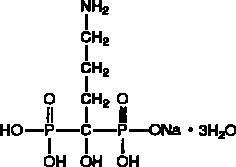
    Alendronate sodium is chemically described as (4-amino-1-hydroxybutylidene) bisphosphonic acid monosodium salt trihydrate.
    The empirical formula of alendronate sodium is C
    image of alendronate sodium structural formula
    Alendronate sodium is a white, crystalline, nonhygroscopic powder. It is soluble in water, very slightly soluble in alcohol, and practically insoluble in chloroform.
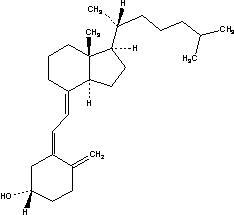
    Cholecalciferol (vitamin D
    The chemical name of cholecalciferol is (3β,5
    image of cholecalciferol structural formula
    Cholecalciferol is a white, crystalline, odorless powder. Cholecalciferol is practically insoluble in water, freely soluble in usual organic solvents, and slightly soluble in vegetable oils.
    FOSAMAX PLUS D for oral administration contains 91.37 mg of alendronate monosodium salt trihydrate, the molar equivalent of 70 mg of free acid, and 70 or 140 mcg of cholecalciferol, equivalent to 2800 or 5600 international units vitamin D, respectively. Each tablet contains the following inactive ingredients: microcrystalline cellulose, lactose anhydrous, medium chain triglycerides, gelatin, croscarmellose sodium, sucrose, colloidal silicon dioxide, magnesium stearate, butylated hydroxytoluene, modified food starch, and sodium aluminum silicate.
    6HOW SUPPLIED/STORAGE AND HANDLING
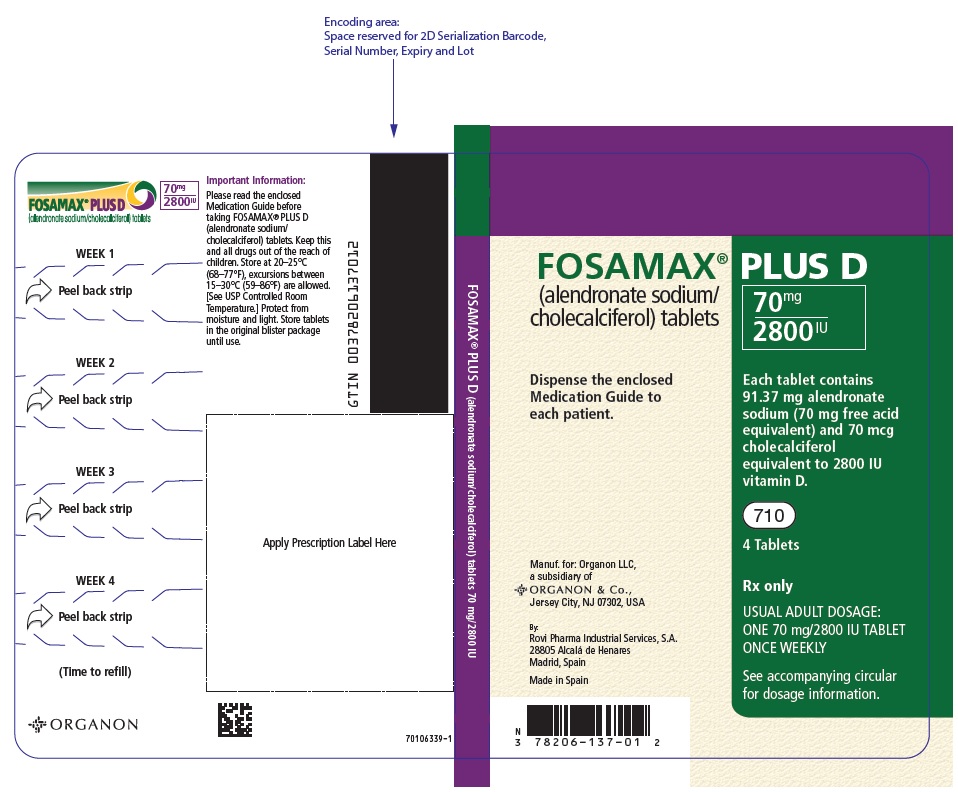
    FOSAMAX PLUS D 70 mg/2800 international units are white to off-white, modified capsule-shaped tablets with code 710 on one side and an outline of a bone image on the other. They are supplied as follows:
    NDC 78206-137-01 unit of use blister packages of 4.
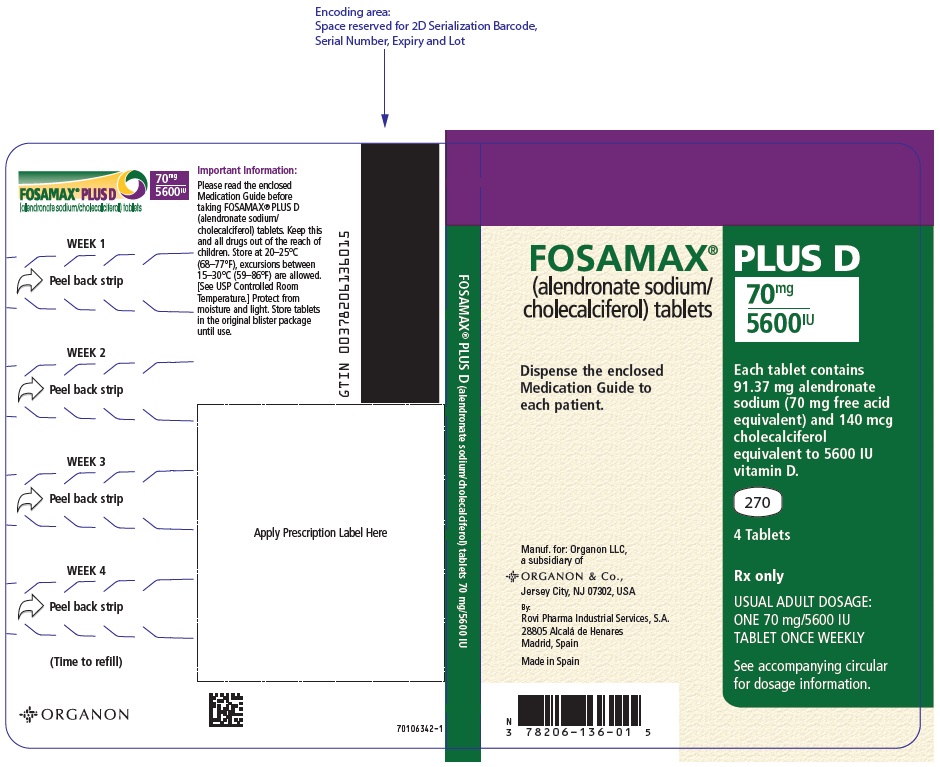
    FOSAMAX PLUS D 70 mg/5600 international units are white to off-white, modified rectangle-shaped tablets with code 270 on one side and an outline of a bone image on the other. They are supplied as follows:
    NDC 78206-136-01 unit of use blister packages of 4
    Storage
    Store at 68°F to 77°F (20°C to 25°C), excursions between 59°F to 86°F (15°C to 30°C). are allowed. [See USP Controlled Room Temperature.] Protect from moisture and light. Store tablets in the original blister package until use.
    7PATIENT COUNSELING INFORMATION
    Advise the patient to read the FDA-approved patient labeling (
    Instruct patients to read the Medication Guide before starting therapy with FOSAMAX PLUS D and to reread it each time the prescription is renewed.
    Osteoporosis Recommendations, Including Calcium and Vitamin D Supplementation
    Instruct patients to take supplemental calcium if intake is inadequate. Patients at increased risk for vitamin D insufficiency (e.g., over the age of 70 years, nursing home bound, or chronically ill) should take additional vitamin D if needed
    Dosing Instructions
    Instruct patients that the expected benefits of FOSAMAX PLUS D may only be obtained when it is taken with plain water the first thing upon arising for the day at least 30 minutes before the first food, beverage, or medication of the day. Even dosing with orange juice or coffee has been shown to markedly reduce the absorption of alendronate
    Instruct patients not to chew or suck on the tablet because of a potential for oropharyngeal ulceration.
    Instruct patients to swallow each tablet of FOSAMAX PLUS D with a full glass of water (6-8 ounces)
    Instruct patients not to take FOSAMAX PLUS D at bedtime or before arising for the day. Patients should be informed that failure to follow these instructions may increase their risk of esophageal problems.
    Instruct patients that if they develop symptoms of esophageal disease (such as difficulty or pain upon swallowing, retrosternal pain or new or worsening heartburn) they should stop taking FOSAMAX PLUS D and consult their physician.
    If patients miss a dose of FOSAMAX PLUS D, instruct patients to take one tablet on the morning after they remember. They should not take two tablets on the same day but should return to taking one tablet once a week, as originally scheduled on their chosen day.
    8PRINCIPAL DISPLAY PANEL - 70 mg/2800 IU Tablet Blister Pack
    FOSAMAX
    (alendronate sodium/
    cholecalciferol) tablets
    70mg
    2800IU
    Dispense the enclosed
    Each tablet contains
    710
    4 Tablets
    Rx only
    USUAL ADULT DOSAGE:
    See accompanying circular
    Manuf. for: Organon LLC,
    By:
    Made in Spain
    PRINCIPAL DISPLAY PANEL - 70 mg/2800 IU Tablet Blister Pack
    9PRINCIPAL DISPLAY PANEL - 70 mg/5600 IU Tablet Blister Pack
    FOSAMAX
    (alendronate sodium/
    cholecalciferol) tablets
    70mg
    5600IU
    Dispense the enclosed
    Each tablet contains
    270
    4 Tablets
    Rx only
    USUAL ADULT DOSAGE:
    See accompanying circular
    Manuf. for: Organon LLC,
    By:
    Made in Spain
    PRINCIPAL DISPLAY PANEL - 70 mg/5600 IU Tablet Blister Pack
    Fosamax has been selected.