Brand Name
Felbatol
Generic Name
Felbamate
View Brand Information FDA approval date: July 29, 1993
Classification: Anti-epileptic Agent
Form: Tablet, Suspension
What is Felbatol (Felbamate)?
Felbamate oral suspension is not indicated as a first line antiepileptic treatment. Felbamate oral suspension is recommended for use only in those patients who respond inadequately to alternative treatments and whose epilepsy is so severe that a substantial risk of aplastic anemia and/or liver failure is deemed acceptable in light of the benefits conferred by its use. If these criteria are met and the patient has been fully advised of the risk, and has provided written acknowledgment, felbamate oral suspension can be considered for either monotherapy or adjunctive therapy in the treatment of partial seizures, with and without generalization, in adults with epilepsy and as adjunctive therapy in the treatment of partial and generalized seizures associated with Lennox-Gastaut syndrome in children.
Approved To Treat
Top Global Experts
There are no experts for this drug
Save this treatment for later
Not sure about your diagnosis?
Related Clinical Trials
There is no clinical trials being done for this treatment
Related Latest Advances
There is no latest advances for this treatment
Brand Information
Felbatol (felbamate)
WARNING
1.
THE USE OF FELBATOL
AMONG FELBATOL
THERE ARE TOO FEW FELBATOL
IN MANAGING PATIENTS ON FELBATOL
IT IS NOT KNOWN WHETHER OR NOT THE RISK OF DEVELOPING APLASTIC ANEMIA CHANGES WITH DURATION OF EXPOSURE. CONSEQUENTLY, IT IS NOT SAFE TO ASSUME THAT A PATIENT WHO HAS BEEN ON FELBATOL
IT IS NOT KNOWN WHETHER OR NOT THE DOSE OF FELBATOL
IT IS NOT KNOWN WHETHER OR NOT CONCOMITANT USE OF ANTIEPILEPTIC DRUGS AND/OR OTHER DRUGS AFFECTS THE INCIDENCE OF APLASTIC ANEMIA.
APLASTIC ANEMIA TYPICALLY DEVELOPS WITHOUT PREMONITORY CLINICAL OR LABORATORY SIGNS, THE FULL BLOWN SYNDROME PRESENTING WITH SIGNS OF INFECTION, BLEEDING, OR ANEMIA. ACCORDINGLY, ROUTINE BLOOD TESTING CANNOT BE RELIABLY USED TO REDUCE THE INCIDENCE OF APLASTIC ANEMIA, BUT, IT WILL, IN SOME CASES, ALLOW THE DETECTION OF THE HEMATOLOGIC CHANGES BEFORE THE SYNDROME DECLARES ITSELF CLINICALLY. FELBATOL
2. HEPATIC FAILURE
EVALUATION OF POSTMARKETING EXPERIENCE SUGGESTS THAT ACUTE LIVER FAILURE IS ASSOCIATED WITH THE USE OF FELBATOL
OF THE CASES REPORTED, ABOUT 67% RESULTED IN DEATH OR LIVER TRANSPLANTATION, USUALLY WITHIN 5 WEEKS OF THE ONSET OF SIGNS AND SYMPTOMS OF LIVER FAILURE. THE EARLIEST ONSET OF SEVERE HEPATIC DYSFUNCTION FOLLOWED SUBSEQUENTLY BY LIVER FAILURE WAS 3 WEEKS AFTER INITIATION OF FELBATOL
IT IS NOT KNOWN WHETHER OR NOT THE RISK OF DEVELOPING HEPATIC FAILURE CHANGES WITH DURATION OF EXPOSURE.
IT IS NOT KNOWN WHETHER OR NOT THE DOSAGE OF FELBATOL
IT IS NOT KNOWN WHETHER CONCOMITANT USE OF OTHER ANTIEPILEPTIC DRUGS AND/OR OTHER DRUGS AFFECT THE INCIDENCE OF HEPATIC FAILURE.
FELBATOL
TREATMENT WITH FELBATOL
FELBATOL
1DESCRIPTION
Felbatol
Felbamate is a white to off-white crystalline powder with a characteristic odor. It is very slightly soluble in water, slightly soluble in ethanol, sparingly soluble in methanol, and freely soluble in dimethyl sulfoxide. The molecular weight is 238.24; felbamate’s molecular formula is C
The inactive ingredients for Felbatol
2CLINICAL STUDIES
The results of controlled clinical trials established the efficacy of Felbatol
2.1Felbatol®Monotherapy Trials in Adults
Felbatol
In the multicenter trial, the percentage of patients who met escape criteria was 40% (18/45) in the Felbatol
2.2Felbatol®Adjunctive Therapy Trials in Adults
A double-blind, placebo-controlled crossover trial consisted of two 10-week outpatient treatment periods. Patients with refractory partial-onset seizures who were receiving phenytoin and carbamazepine at therapeutic levels were administered Felbatol
Felbatol
2.3Felbatol®Adjunctive Therapy Trial in Children with Lennox-Gastaut Syndrome
In a 70-day double-blind, placebo-controlled add-on trial in the Lennox-Gastaut syndrome, Felbatol
When efficacy was analyzed by gender in four well-controlled trials of felbamate as adjunctive and monotherapy for partial-onset seizures and Lennox-Gastaut syndrome, a similar response was seen in 122 males and 142 females.
3INDICATIONS AND USAGE
Felbatol
If these criteria are met and the patient has been fully advised of the risk and has provided written acknowledgment, Felbatol
4CONTRAINDICATIONS
Felbatol
5WARNINGS
See
Antiepileptic drugs should not be suddenly discontinued because of the possibility of increasing seizure frequency.
Suicidal Behavior and Ideation
Antiepileptic drugs (AEDs) including Felbatol
Pooled analyses of 199 placebo-controlled clinical trials (mono- and adjunctive therapy) of 11 different AEDs showed that patients randomized to one of the AEDs had approximately twice the risk (adjusted Relative Risk 1.8, 95% CI:1.2, 2.7) of suicidal thinking or behavior compared to patients randomized to placebo. In these trials, which had a median treatment duration of 12 weeks, the estimated incidence rate of suicidal behavior or ideation among 27,863 AED-treated patients was 0.43%, compared to 0.24% among 16,029 placebo-treated patients, representing an increase of approximately one case of suicidal thinking or behavior for every 530 patients treated. There were four suicides in drug-treated patients in the trials and none in placebo-treated patients, but the number is too small to allow any conclusion about drug effect on suicide.
The increased risk of suicidal thoughts or behavior with AEDs was observed as early as one week after starting drug treatment with AEDs and persisted for the duration of treatment assessed. Because most trials included in the analysis did not extend beyond 24 weeks, the risk of suicidal thoughts or behavior beyond 24 weeks could not be assessed.
The risk of suicidal thoughts or behavior was generally consistent among drugs in the data analyzed. The finding of increased risk with AEDs of varying mechanisms of action and across a range of indications suggests that the risk applies to all AEDs used for any indication. The risk did not vary substantially by age (5-100 years) in the clinical trials analyzed.
Table 1 shows absolute and relative risk by indication for all evaluated AEDs.
The relative risk for suicidal thoughts or behavior was higher in clinical trials for epilepsy than in clinical trials for psychiatric or other conditions, but the absolute risk differences were similar for the epilepsy and psychiatric indications.
Anyone considering prescribing Felbatol
Patients, their caregivers, and families should be informed that AEDs increase the risk of suicidal thoughts and behavior and should be advised of the need to be alert for the emergence or worsening of the signs and symptoms of depression, any unusual changes in mood or behavior, or the emergence of suicidal thoughts, behavior, or thoughts about self-harm. Behaviors of concern should be reported immediately to healthcare providers.
6ADVERSE REACTIONS
To report SUSPECTED ADVERSE REACTIONS, contact Viatris at 1-877-446-3679 (1-877-4-INFO-RX) or FDA at 1-800-FDA-1088 or www.fda.gov/medwatch.
The most common adverse reactions seen in association with Felbatol
The most common adverse reactions seen in association with Felbatol
The dropout rate because of adverse experiences or intercurrent illnesses among adult felbamate patients was 12 percent (120/977). The dropout rate because of adverse experiences or intercurrent illnesses among pediatric felbamate patients was six percent (22/357). In adults, the body systems associated with causing these withdrawals in order of frequency were: digestive (4.3%), psychological (2.2%), whole body (1.7%), neurological (1.5%), and dermatological (1.5%). In children, the body systems associated with causing these withdrawals in order of frequency were: digestive (1.7%), neurological (1.4%), dermatological (1.4%), psychological (1.1%), and whole body (1.0%). In adults, specific events with an incidence of 1% or greater associated with causing these withdrawals, in order of frequency were: anorexia (1.6%), nausea (1.4%), rash (1.2%), and weight decrease (1.1%). In children, specific events with an incidence of 1% or greater associated with causing these withdrawals, in order of frequency was rash (1.1%).
Incidence in Clinical Trials
The prescriber should be aware that the figures cited in the following table cannot be used to predict the incidence of side effects in the course of usual medical practice where patient characteristics and other factors differ from those which prevailed in the clinical trials. Similarly, the cited frequencies cannot be compared with figures obtained from other clinical investigations involving different investigators, treatments, and uses including the use of Felbatol
Adults
Incidence in Controlled Clinical Trials – Monotherapy Studies in Adults
The table that follows enumerates adverse events that occurred at an incidence of 2% or more among 58 adult patients who received Felbatol
Incidence in Controlled Add-On Clinical Studies in Adults
Table 4 enumerates adverse events that occurred at an incidence of 2% or more among 114 adult patients who received Felbatol
Many adverse experiences that occurred during adjunctive therapy may be a result of drug interactions. Adverse experiences during adjunctive therapy typically resolved with conversion to monotherapy, or with adjustment of the dosage of other antiepileptic drugs.
Children
Incidence in a Controlled Add-On Trial in Children with Lennox-Gastaut Syndrome
Table 5 enumerates adverse events that occurred more than once among 31 pediatric patients who received Felbatol
Other Events Observed in Association with the Administration of Felbatol
In the paragraphs that follow, the adverse clinical events, other than those in the preceding tables, that occurred in a total of 977 adults and 357 children exposed to Felbatol
Events are classified within body system categories and enumerated in order of decreasing frequency using the following definitions: frequent adverse events are defined as those occurring on one or more occasions in at least 1/100 patients; infrequent adverse events are those occurring in 1/100–1/1000 patients; and rare events are those occurring in fewer than 1/1000 patients.
Event frequencies are calculated as the number of patients reporting an event divided by the total number of patients (N=1334) exposed to Felbatol
Body as a Whole: Frequent: Weight increase, asthenia, malaise, influenza-like symptoms; Rare: anaphylactoid reaction, chest pain substernal.
Cardiovascular: Frequent: Palpitation, tachycardia; Rare: supraventricular tachycardia.
Central Nervous System: Frequent: Agitation, psychological disturbance, aggressive reaction; Infrequent: hallucination, euphoria, suicide attempt, migraine.
Digestive: Frequent: SGOT increased; Infrequent: esophagitis, appetite increased; Rare: GGT elevated.
Hematologic: Infrequent: Lymphadenopathy, leukopenia, leukocytosis, thrombocytopenia, granulocytopenia; Rare: antinuclear factor test positive, qualitative platelet disorder, agranulocytosis.
Metabolic/Nutritional: Infrequent: Hypokalemia, hyponatremia, LDH increased, alkaline phosphatase increased, hypophosphatemia; Rare: creatinine phosphokinase increased.
Musculoskeletal: Infrequent: Dystonia.
Dermatological: Frequent: Pruritus; Infrequent: urticaria, bullous eruption; Rare: buccal mucous membrane swelling, Stevens-Johnson Syndrome.
Special Senses: Rare: Photosensitivity allergic reaction.
Postmarketing Adverse Event Reports
Voluntary reports of adverse events in patients taking Felbatol
Body as a Whole: neoplasm, sepsis, L.E. syndrome, SIDS, sudden death, edema, hypothermia, rigors, hyperpyrexia.
Cardiovascular: atrial fibrillation, atrial arrhythmia, cardiac arrest, torsade de pointes, cardiac failure, hypotension, hypertension, flushing, thrombophlebitis, ischemic necrosis, gangrene, peripheral ischemia, bradycardia, Henoch-Schönlein purpura (vasculitis).
Central & Peripheral Nervous System: delusion, paralysis, mononeuritis, cerebrovascular disorder, cerebral edema, coma, manic reaction, encephalopathy, paranoid reaction, nystagmus, choreoathetosis, extrapyramidal disorder, confusion, psychosis, status epilepticus, dyskinesia, dysarthria, respiratory depression, apathy, concentration impaired.
Dermatological: abnormal body odor, sweating, lichen planus, livedo reticularis, alopecia, toxic epidermal necrolysis.
Digestive: (Refer to WARNINGS) hepatitis, hepatic failure, G.I. hemorrhage, hyperammonemia, pancreatitis, hematemesis, gastritis, rectal hemorrhage, flatulence, gingival bleeding, acquired megacolon, ileus, intestinal obstruction, enteritis, ulcerative stomatitis, glossitis, dysphagia, jaundice, gastric ulcer, gastric dilation, gastroesophageal reflux.
Fetal Disorders: fetal death, microcephaly, genital malformation, anencephaly, encephalocele.
Hematologic: (Refer to WARNINGS) increased and decreased prothrombin time, anemia, hypochromic anemia, aplastic anemia, pancytopenia, hemolytic uremic syndrome, increased mean corpuscular volume (mcv) with and without anemia, coagulation disorder, embolism-limb, disseminated intravascular coagulation, eosinophilia, hemolytic anemia, leukemia, including myelogenous leukemia, and lymphoma, including T-cell and B-cell lymphoproliferative disorders.
Metabolic/Nutritional: hypernatremia, hypoglycemia, SIADH, hypomagnesemia, dehydration, hyperglycemia, hypocalcemia.
Musculoskeletal: arthralgia, muscle weakness, involuntary muscle contraction, rhabdomyolysis.
Respiratory: dyspnea, pneumonia, pneumonitis, hypoxia, epistaxis, pleural effusion, respiratory insufficiency, pulmonary hemorrhage, asthma.
Special Senses: hemianopsia, decreased hearing, conjunctivitis.
Urogenital: menstrual disorder, acute renal failure, hepatorenal syndrome, hematuria, urinary retention, nephrosis, vaginal hemorrhage, abnormal renal function, dysuria, placental disorder.
7OVERDOSAGE
Four subjects inadvertently received Felbatol
General supportive measures should be employed if overdosage occurs. It is not known if felbamate is dialyzable.
8DOSAGE AND ADMINISTRATION
Felbatol
8.1Dosage Adjustment in the Renally Impaired
Felbamate should be used with caution in patients with renal dysfunction. In the renally impaired, starting and maintenance doses should be reduced by one-half (see
8.1.1Adults (14 years of age and over)
The majority of patients received 3600 mg/day in clinical trials evaluating its use as both monotherapy and adjunctive therapy.
Monotherapy: (Initial therapy) Felbatol® (felbamate) has not been systematically evaluated as initial monotherapy. Initiate Felbatol® (felbamate) at 1200 mg/day in divided doses three or four times daily. The prescriber is advised to titrate previously untreated patients under close clinical supervision, increasing the dosage in 600-mg increments every 2 weeks to 2400 mg/day based on clinical response and thereafter to 3600 mg/day if clinically indicated.
Conversion to Monotherapy: Initiate Felbatol® at 1200 mg/day in divided doses three or four times daily. Reduce the dosage of concomitant AEDs by one-third at initiation of Felbatol® therapy. At week 2, increase the Felbatol® dosage to 2400 mg/day while reducing the dosage of other AEDs up to an additional one-third of their original dosage. At week 3, increase the Felbatol® dosage up to 3600 mg/day and continue to reduce the dosage of other AEDs as clinically indicated.
Adjunctive Therapy: Felbatol® should be added at 1200 mg/day in divided doses three or four times daily while reducing present AEDs by 20% in order to control plasma concentrations of concurrent phenytoin, valproic acid, phenobarbital, and carbamazepine and its metabolites. Further reductions of the concomitant AEDs dosage may be necessary to minimize side effects due to drug interactions. Increase the dosage of Felbatol® by 1200 mg/day increments at weekly intervals to 3600 mg/day. Most side effects seen during Felbatol® adjunctive therapy resolve as the dosage of concomitant AEDs is decreased.
While the above Felbatol
8.1.2Children with Lennox-Gastaut Syndrome (Ages 2–14 years)
Adjunctive Therapy: Felbatol® should be added at 15 mg/kg/day in divided doses three or four times daily while reducing present AEDs by 20% in order to control plasma levels of concurrent phenytoin, valproic acid, phenobarbital, and carbamazepine and its metabolites. Further reductions of the concomitant AEDs dosage may be necessary to minimize side effects due to drug interactions. Increase the dosage of Felbatol® by 15 mg/kg/day increments at weekly intervals to 45 mg/kg/day. Most side effects seen during Felbatol® adjunctive therapy resolve as the dosage of concomitant AEDs is decreased.
9HOW SUPPLIED
Felbatol
Shake suspension well before using. Store at controlled room temperature 20°–25°C (68°–77°F). Dispense in tight container.
10PATIENT/PHYSICIAN ACKNOWLEDGMENT FORM
For more information, call Viatris at 1-877-446-3679 (1-877-4-INFO-RX).
FELBATOL is a registered trademark of Meda Pharmaceuticals Inc., a Viatris Company.
© 2025 Viatris Inc.
Distributed by:
201110-01
VS:SOV:FELT:R1m/VS:SOV:MG:FELT:R1m
11Medication Guide
FELBATOL (Fel-ba-taal) (felbamate)
Tablets and Oral Suspension
Read this Medication Guide before you start taking FELBATOL and each time you get a refill. There may be new information. This information does not take the place of talking to your healthcare provider about your medical condition or treatment.
What is the most important information I should know about FELBATOL?
Do not stop taking FELBATOL without first talking to your healthcare provider.
Stopping FELBATOL suddenly can cause serious problems.
FELBATOL can cause serious side effects, including:
1. FELBATOL may cause serious blood problems that may be life-threatening.
Call your healthcare provider right away if you have any of the following symptoms:
- Fever, sore throat or other infections that come and go or do not go away
- Frequent infections or an infection that does not go away
- Easy bruising
- Red or purple spots on your body
- Bleeding gums or nose bleeds
- Severe fatigue or weakness
2. Liver problems that may be life-threatening. Call your healthcare provider right away if you have any of these symptoms:
- yellowing of your skin or the whites of your eyes (jaundice)
- dark urine
- nausea or vomiting
- loss of appetite
- pain on the right side of your stomach (abdomen)
3. Like other antiepileptic drugs, FELBATOL may cause suicidal thoughts or actions in a very small number of people, about 1 in 500.
Call your healthcare provider right away if you have any of these symptoms, especially if they are new, worse, or worry you:
- thoughts about suicide or dying
- new or worse depression
- attempts to commit suicide
- feeling agitated or restless
- new or worse anxiety
- trouble sleeping (insomnia)
- panic attacks
- acting aggressive, being angry, or violent
- new or worse irritability
- acting on dangerous impulses
- an extreme increase in activity and talking (mania)
- other unusual changes in behavior or mood
How can I watch for early symptoms of suicidal thoughts and actions?
- Pay attention to any changes, especially sudden changes, in mood, behaviors, thoughts, or feelings.
- Keep all follow-up visits with your healthcare provider as scheduled.
Call your healthcare provider between visits as needed, especially if you are worried about symptoms.
Do not stop FELBATOL without first talking to a healthcare provider.
Stopping FELBATOL suddenly can cause serious problems. You should talk to your healthcare provider before stopping. Stopping a seizure medicine suddenly in a patient who has epilepsy can cause seizures.
Suicidal thoughts or actions can be caused by things other than medicines. If you have suicidal thoughts or actions, your healthcare provider may check for other causes.
What is FELBATOL?
FELBATOL is a prescription medicine used when other treatments have failed in:
- adults alone or with other medicines to treat:
- children with other medicines to treat:
Who should not take FELBATOL?
Do not take FELBATOL if you:
- are allergic to felbamate, carbamates or any of the ingredients in FELBATOL.
See the end of this Medication Guide for a complete list of ingredients in FELBATOL.
- have or have had blood problems
- have or have had liver problems
What should I tell my healthcare provider before taking FELBATOL?
Before you take FELBATOL, tell your healthcare provider if you:
- have kidney problems
- have or have had depression, mood problems, or suicidal thoughts or behavior
- have any other medical conditions
- are pregnant or plan to become pregnant. It is not known if FELBATOL can harm your unborn baby. Tell your healthcare provider right away if you become pregnant while taking FELBATOL. You and your healthcare provider will decide if you should take FELBATOL while you are pregnant.
- are breastfeeding or plan to breastfeed. FELBATOL may pass into your breast milk. You and your healthcare provider should decide if you should take FELBATOL while you breastfeed.
Tell your healthcare provider about all the medicines you take, including prescription and non-prescription medicines, vitamins, and herbal supplements.
Taking FELBATOL with certain other medicines can cause side effects or affect how well they work. Do not start or stop other medicines without talking to your healthcare provider.
Know the medicines you take. Keep a list of them and show it to your healthcare provider and pharmacist when you get a new medicine.
How should I take FELBATOL?
- Take FELBATOL exactly as your healthcare provider tells you. Your healthcare provider will tell you how much FELBATOL to take and when to take it.
- Your healthcare provider may change your dose of FELBATOL. Do not change your dose of FELBATOL without talking to your healthcare provider.
- Because of the risk of serious blood and liver problems, your healthcare provider may do blood tests before you start and while you take FELBATOL.
- If you take too much FELBATOL, call your healthcare provider or local Poison Control Center right away.
- Do not stop FELBATOL without first talking to your healthcare provider.
What should I avoid while taking FELBATOL?
- FELBATOL can cause drowsiness and dizziness. Do not drink alcohol or take other medicines that make you sleepy or dizzy while taking FELBATOL, until you talk with your doctor. Taking FELBATOL with alcohol or drugs that cause sleepiness or dizziness may make your sleepiness or dizziness worse.
What are the possible side effects of FELBATOL?
See “What is the most important information I should know about FELBATOL?”
FELBATOL may cause serious side effects including:
The most common side effects of FELBATOL include:
- weight loss
- trouble sleeping
- sleepiness
- vomiting
- nausea
- headache
- changes in the way that food tastes
- dizziness
- double-vision
These are not all the possible side effects of FELBATOL. For more information, ask your healthcare provider or pharmacist.
Tell your healthcare provider if you have any side effect that bothers you or that does not go away.
Call your doctor for medical advice about side effects. You may report side effects to FDA at 1-800-FDA-1088.
How should I store FELBATOL?
- Store FELBATOL at room temperature between 68°F to 77°F (20°C to 25°C).
Keep FELBATOL and all medicines out of the reach of children.
General information about FELBATOL.
Medicines are sometimes prescribed for purposes other than those listed in a Medication Guide. Do not use FELBATOL for a condition for which it was not prescribed. Do not give FELBATOL to other people, even if they have the same symptoms that you have. It may harm them.
This Medication Guide summarizes the most important information about FELBATOL. If you would like more information, talk with your healthcare provider. You can ask your pharmacist or healthcare provider for information about FELBATOL that is written for health professionals.
What are the ingredients in FELBATOL?
Active Ingredient: felbamate
Tablet Inactive Ingredients: starch, microcrystalline cellulose, croscarmellose sodium, lactose, magnesium stearate, FD&C Yellow No. 6, D&C Yellow No. 10, and FD&C Red No. 40 (600 mg tablets only).
Suspension Inactive Ingredients: sorbitol, glycerin, microcrystalline cellulose, carboxymethylcellulose sodium, simethicone, polysorbate 80, methylparaben, saccharin sodium, propylparaben, FD&C Yellow No. 6, FD&C Red No. 40, flavorings, and purified water.
For more information, call Viatris at 1-877-446-3679 (1-877-4-INFO-RX).
FELBATOL is a registered trademark of Meda Pharmaceuticals Inc., a Viatris Company.
© 2025 Viatris Inc.
Distributed by:
This Medication Guide has been approved by the U.S. Food and Drug Administration.
Rx Only
VS:SOV:MG:FELT:R1m
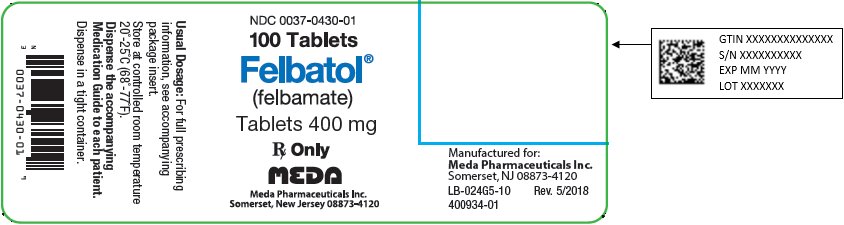
12PRINCIPAL DISPLAY PANEL – 100 count Bottle, 400 mg Tablet
NDC 0037-0430-01
100 Tablets
Felbatol
(felbamate)
(felbamate)
Tablets 400 mg
Rx only
FELBATOL is a registered trademark of
© 2025 Viatris Inc.
Usual Dosage: For full prescribing
information, see accompanying
package insert.
information, see accompanying
package insert.
Store at controlled room temperature
Dispense the accompanying
Medication Guide to each patient.
Medication Guide to each patient.
Dispense in a tight container.
Distributed by:
VSSOV0430A1
Rev. 8/2025
13PRINCIPAL DISPLAY PANEL – 100 count Bottle, 600 mg Tablet
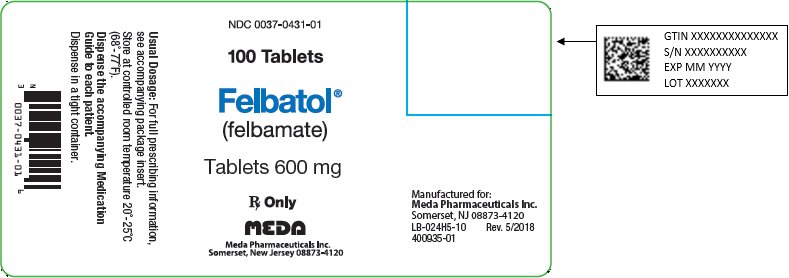
NDC 0037-0431-01
100 Tablets
Felbatol
(felbamate)
(felbamate)
Tablets 600 mg
Rx only
FELBATOL is a registered trademark of
© 2025 Viatris Inc.
Usual Dosage: For full prescribing
information, see accompanying
package insert.
information, see accompanying
package insert.
Store at controlled room temperature
Dispense the accompanying
Medication Guide to each patient.
Medication Guide to each patient.
Dispense in a tight container.
Distributed by:
VSSOV0431A1
Rev. 8/2025
14PRINCIPAL DISPLAY PANEL – 8 fl oz (237 mL) Bottle, 600 mg Suspension
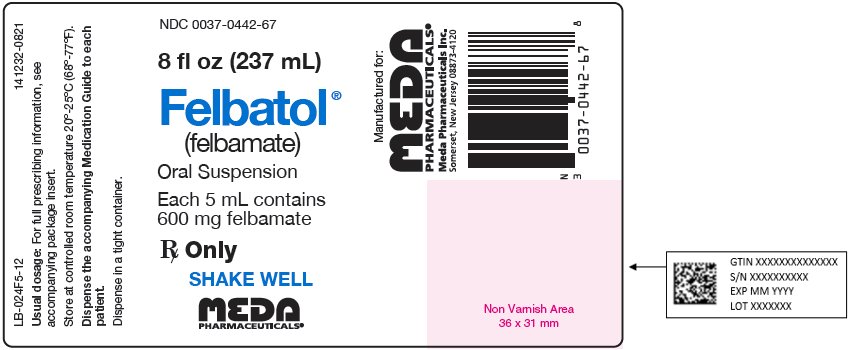
NDC 0037-0442-67
8 fl oz (237 mL)
Felbatol
(felbamate)
Oral Suspension
(felbamate)
Oral Suspension
Each 5 mL contains
Rx Only
SHAKE WELL
MEDA
PHARMACEUTICALS
PHARMACEUTICALS
LB-024F5-12 141232-0821
Usual Dosage: For full prescribing information, see
accompanying package insert.
accompanying package insert.
Store at controlled room temperature 20°-25°C (68°-77°F).
Dispense the accompanying Medication Guide to each
Dispense in a tight container.
Manufactured for:
