Brand Name

Nexletol

Generic Name
Bempedoic
View Brand Information
FDA approval date: March 06, 2020
Classification: Adenosine Triphosphate-Citrate Lyase Inhibitor
Form: Tablet

What is Nexletol (Bempedoic)?

NEXLETOL is indicated: to reduce the risk of major adverse cardiovascular events in adults at increased risk for these events who are unable to take recommended statin therapy . as an adjunct to diet and exercise, in combination with other low-density lipoprotein cholesterol lowering therapies or alone when concomitant LDL-C lowering therapy is not possible, to reduce LDL-C in adults with hypercholesterolemia, including heterozygous familial hypercholesterolemia . NEXLETOL, an adenosine triphosphate-citrate lyase inhibitor, is indicated: to reduce the risk of major adverse cardiovascular events in adults at increased risk for these events who are unable to take recommended statin therapy . as an adjunct to diet and exercise, in combination with other low-density lipoprotein cholesterol lowering therapies, or alone when concomitant LDL-C lowering therapy is not possible to reduce LDL-C in adults with hypercholesterolemia, including heterozygous familial hypercholesterolemia .

Related Clinical Trials

Cholesterol and Inflammation Lowering Via Bempedoic Acid, an ACL-inhibiting Regimen in HIV Trial (CLEAR HIV Trial)

Summary: This is a randomized placebo-controlled study in treated and suppressed HIV-infected individuals aged ≥40 years with either known CVD or 1 CVD risk factor to study the effect of Bempedoic acid (BA) on safety, arterial inflammation as assessed by FDG-PET/CT, lipids, inflammation, immune activation, cardiometabolic indices, and non-calcified plaque (NCP) in the coronary arteries (assessed by coronar...

Effectiveness and Safety of Bempedoic Acid in Combination With Ezetimibe and Either Rosuvastatin or Atorvastatin in Patients With Primary Hypercholesterolemia or Mixed Dyslipidemia: an Observational Study

Summary: Data on the real-world use and effectiveness and safety of bempedoic acid combined with both a statin and ezetimibe in clinical practice is limited. There is an increased focus on using combination therapy to lower LDL-C.

A Randomized, Single-Center, Open-Label, Single-Dose, 4-Period, 2-Sequence, Fully Replicate Crossover Study To Assess The Bioequivalence Of A Test Fixed Dose Combination Product Versus The Co-Administered Individual Reference Products Containing Bempedoic Acid 180 MG, Ezetimibe 10 mg And Atorvastatin 40 mg In Healthy Participants

Summary: Monotherapies for lowering LDL-C often do not achieve target lipid levels because they act on a single pathway, which may be insufficient in patients with high cardiovascular risk or complex lipid profiles. Triple combination therapies, targeting multiple mechanisms of cholesterol metabolism simultaneously, have demonstrated superior LDL-C reduction and better achievement of guideline recommended ...

Brand Information

Nexletol (Bempedoic Acid)
1INDICATIONS AND USAGE
NEXLETOL is indicated:
  • to reduce the risk of major adverse cardiovascular events (cardiovascular death, myocardial infarction, stroke, or coronary revascularization) in adults at increased risk for these events who are unable to take recommended statin therapy (including those not taking a statin).
  • as an adjunct to diet and exercise, in combination with other low-density lipoprotein cholesterol (LDL-C) lowering therapies or alone when concomitant LDL-C lowering therapy is not possible, to reduce LDL-C in adults with hypercholesterolemia, including heterozygous familial hypercholesterolemia (HeFH).
2DOSAGE FORMS AND STRENGTHS
NEXLETOL is available as:
  • Tablets: 180 mg, white to off-white, oval shaped, debossed with "180" on one side and "ESP" on the other side.
3CONTRAINDICATIONS
NEXLETOL is contraindicated in patients with a prior serious hypersensitivity reaction to bempedoic acid or any of the excipients in NEXLETOL. Serious hypersensitivity reactions, such as angioedema, have occurred
4ADVERSE REACTIONS
The following clinically significant adverse reactions are described elsewhere in the labeling:
  • Hyperuricemia
  • Tendon Rupture
4.1Clinical Trials Experience
Because clinical trials are conducted under widely varying conditions, adverse reaction rates observed in the clinical trials of a drug cannot be directly compared to rates in the clinical trials of another drug and may not reflect the rates observed in clinical practice.
The data in Table 1 reflect exposure to NEXLETOL in two placebo-controlled primary hypercholesterolemia trials that included 2,009 patients treated with NEXLETOL for 52 weeks (median treatment duration of 52 weeks)
In the primary hypercholesterolemia trials, adverse reactions led to discontinuation of treatment in 11% of NEXLETOL-treated patients and 8% of placebo-treated patients. The most common reasons for NEXLETOL treatment discontinuation were muscle spasms (0.5% versus 0.3% placebo), diarrhea (0.4% versus 0.1% placebo), and pain in extremity (0.3% versus 0.0% placebo). Adverse reactions reported in at least 2% of NEXLETOL-treated patients and more frequently than in placebo-treated patients are shown in Table 1.
In the cardiovascular outcomes trial, in which 7,001 patients were exposed to NEXLETOL and 6,964 patients were exposed to placebo for a median of 3.1 years
4.2Postmarketing Experience
The following adverse reactions have been identified during postapproval use of NEXLETOL. Because these reactions are reported voluntarily from a population of uncertain size, it is not always possible to reliably estimate their frequency or establish a causal relationship to drug exposure.
Immune System Disorders: Hypersensitivity reactions including: angioedema, wheezing, rash, and urticaria.
5DRUG INTERACTIONS
Table 3 includes a list of drugs with clinically important drug interactions when administered concomitantly with NEXLETOL and instructions for preventing or managing them.
6OVERDOSAGE
There is no clinical experience with NEXLETOL overdose. In the event of an overdosage, consider contacting the Poison Help line (1-800-222-1222) or a medical toxicologist for additional overdosage management recommendations.
7DESCRIPTION
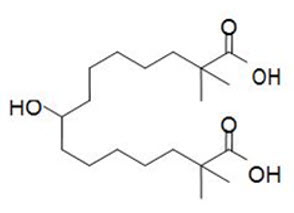
NEXLETOL tablets, for oral use, contain bempedoic acid, an adenosine triphosphate-citrate lyase (ACL) inhibitor. The chemical name for bempedoic acid is 8-hydroxy-2,2,14,14-tetramethyl-pentadecanedioic acid. The molecular formula is C
Structural formula:
Chemical Structure
Each film-coated tablet of NEXLETOL contains 180 mg of bempedoic acid and the following inactive ingredients: colloidal silicon dioxide, hydroxyl propyl cellulose, lactose monohydrate, magnesium stearate, microcrystalline cellulose, and sodium starch glycolate. The film coating comprises of partially hydrolyzed polyvinyl alcohol, polyethylene glycol, talc, and titanium dioxide.
8PATIENT COUNSELING INFORMATION
Advise patients to read the FDA-approved patient labeling (Patient Information).
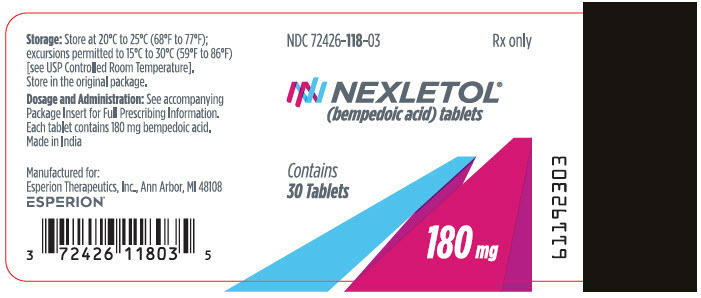
9PRINCIPAL DISPLAY PANEL - 180 mg Tablet Bottle Label
NDC 72426-118-03
NEXLETOL
Contains
180 mg
PRINCIPAL DISPLAY PANEL - 180 mg Tablet Bottle Label