Overview
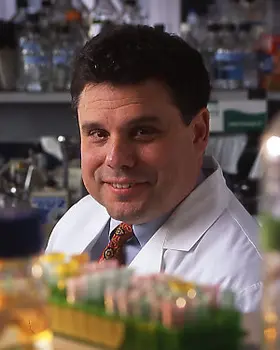
Richard F. Ambinder, M.D., Ph.D., currently serves as the James B. Murphy Professor of Oncology and the Director of the Division of Hematologic Malignancies at the Johns Hopkins Kimmel Cancer Center. He is program co-leader of the Hematologic Malignancies and Bone Marrow Transplantation Program and leads the AIDS Malignancy Consortium (AMC) site at Johns Hopkins and the AMC Translational Sciences Working Group nationally. Dr. Ambinder graduated from Harvard College with a Bachelor’s degree in biochemistry, after which he received his medical degree from the Johns Hopkins University School of Medicine before completing his residency at the Johns Hopkins Hospital. He also earned his Ph.D. in pharmacology from the Johns Hopkins University, and completed his oncology fellowship at Johns Hopkins. Within the clinic, Dr. Ambinder is active in the treatment of lymphoma and Kaposi’s sarcoma. Dr. Ambinder’s research is focused on exploring opportunities to prevent or treat cancer with viral infections. Virus-associated tumors are among the most common malignancies in certain populations and regions. For instance, Burkitt's lymphoma (EBV) and Kaposi's sarcoma (KSHV) are common in equatorial Africa, nasopharyngeal carcinoma (EBV) is common in southern Chinese populations or those with southern Chinese origins, and immunoblastic lymphomas (EBV) are common in immunocompromised patients (organ transplant recipients, AIDS patients, etc). Thus, Dr. Ambinder’s new approaches to prevention, diagnosis, and treatment stand to have a direct impact on the lives of cancer patients around the globe. Additionally, the study of how viruses can impact these tumors is important in creating model systems for the development of new approaches to cancer care. Currently, many immunotherapies target unidentified antigens, making the measurement of relevant immune responses problematic at best. However, in EBV-associated tumors the antigens are well defined, thus allowing the Ambinder lab to define the epitope-specific cellular immune responses. As a result of this breakthrough, interventions designed to alter immune response —whether they be vaccine based interventions, adoptive immunotherapy interventions, or pharmacologic interventions — may all be assessed in terms of relevant surrogate markers. Much in the same way the treatment of Hodgkin's lymphoma with radiotherapy and chemotherapy paved the way for the modern approach to cancer treatment more broadly, the treatment of EBV-associated tumors (including Hodgkin's lymphoma) may pave the way to the more generalized use of these modalities to treat a myriad of cancer types.
Dr. Ambinder is highly rated in 23 conditions, according to our data. His top areas of expertise are Hodgkin Lymphoma, Non-Hodgkin Lymphoma, B-Cell Lymphoma, Tissue Biopsy, and Bone Marrow Aspiration.
His clinical research consists of co-authoring 187 peer reviewed articles and participating in 16 clinical trials. MediFind looks at clinical research from the past 15 years.
Insurance
Accepted insurance can change. Please verify directly with the provider.
Accepted insurance plans:
- EPO
- HMO
- POS
- PPO
- HMO
- POS
- PPO
- EPO
- HMO
- PPO
- INSURANCE PLAN
- MEDICARE PDP
- PPO
- HMO
- POS
- PPO
- HMO
- INDEMNITY
- POS
- PPO
- HMO
- MANAGED MEDICAID PLAN
- MEDICARE MAPD
- MEDICARE-MEDICAID PLAN
- OTHER MEDICAID
- STATE MEDICAID
- EPO
- HMO
- POS
- PPO
- EPO
- HMO
- INSURANCE PLAN
- MANAGED MEDICAID PLAN
- MEDICARE MAPD
- MEDICARE PDP
- MEDICARE SNP
- MEDICARE-MEDICAID PLAN
- OTHER MEDICARE
- OTHER MEDICARE PART D
Locations
401 North Broadway Street, Weinberg BLDG, Weinberg BLDG, Baltimore, MD 21287
Clinical Research
Clinical research consists of overseeing clinical studies of patients undergoing new treatments and therapies, and publishing articles in peer reviewed medical journals. Providers who actively participate in clinical research are generally at the forefront of the fields and aware of the most up-to-date advances in treatments for their patients.
16 Clinical Trials

Skip Viragh Outpatient Cancer Center
Dr. Matthias Holdhoff is a medical oncologist and co-director of the Brain Cancer Disease Group at the Sidney Kimmel Comprehensive Cancer Center at Johns Hopkins. He is a professor of oncology, neurology and neurological surgery at Johns Hopkins University School of Medicine. Dr. Holdhoff’s expertise is in primary brain cancers and central nervous system lymphomas. He earned his medical degree from Freie Universität Berlin, received his doctorate degree at Charité University Medicine Berlin. Dr. Holdhoff completed residency training in internal medicine at Johns Hopkins Bayview Medical Center, followed by a fellowship in medical oncology at Johns Hopkins Hospital with research training at the Ludwig Center for Cancer Genetics and Therapeutics (Kinzler-Vogelstein lab). As a clinical investigator in neuro-oncology, his research is focused on novel trials and translational biomarker studies in malignant gliomas and primary central nervous system lymphomas. He has led and contributed to numerous clinical trials, publications and presentations. Dr. Holdhoff serves as the director of the solid tumor inpatient service at the Sidney Kimmel Comprehensive Cancer Center. He is passionately involved in mentoring and teaching of fellows, residents and students. He is the director of the UCNS-certified neuro-oncology fellowship program at Johns Hopkins, and he is a teaching attending physician for the Osler internal medicine residency program. Dr. Holdhoff is highly rated in 19 conditions, according to our data. His top areas of expertise are Glioma, Glioblastoma, Astrocytoma, and Brain Tumor.

Sidney Kimmel Comprehensive Cancer Center
Dr. DeZern is a Professor of Oncology and Medicine at The Johns Hopkins University School of Medicine. She is active in the Division of Hematology Malignancies, Leukemia Program at the Sidney Kimmel Comprehensive Cancer Center at Johns Hopkins. Dr. DeZern has expertise in aplastic anemia, myelodysplastic syndromes, paroxysmal nocturnal hemoglobinuria, acute myeloid leukemia, and bone marrow transplantation. Dr. DeZern received her medical degree at The Johns Hopkins University School of Medicine. She completed a residency in internal medicine at Johns Hopkins, followed by fellowships in medical oncology and hematology, as well as obtained a Masters in Clinical Investigations at the Bloomberg School of Public health. Dr. DeZern is a member of the American Society of Hematology, the American Society of Clinical Oncology, and the American Society for Transplantation and Cellular Therapy. Dr. DeZern’s principle research activities consist of designing and conducting clinical trials that test investigational new therapies and approaches in the treatment of bone marrow failure (aplastic anemia and myelodysplastic syndromes). She has specific expertise in the use of alternative donor bone marrow transplantation in patients with severe aplastic anemia and trials of novel therapeutics for patients with myelodysplastic syndromes. Additionally, she has taken a rigorous approach to the study of diagnostics and supportive case (such as transfusion practices) in these patient populations. She is or has been the Principal Investigator for a number of multicenter trials in collaboration with the MDS Clinical Research Consortium, the Eastern Co-operative Oncology Group (ECOG)-ACRIN and now the Bone Marrow Trials Clinical Trials Network (BMTCTN). She is the Study Chair for the multi-site BMTCTN study (CHAMP) investigating the role of haploidentical donor transplantation using post-transplantation cyclophosphamide in patients with relapsed several aplastic anemia. Dr. DeZern is the local PI as well as the Deputy Chair for The National MDS Study, a collaborative natural history study of the NHLBI and the NCI. As a clinical investigator with a focus on translation of novel treatments to the clinic, Dr. DeZern’s goal is to improve outcomes for patients with bone marrow failure at the bedside and in her research environment. Dr. Dezern is highly rated in 27 conditions, according to our data. Her top areas of expertise are Myelodysplastic Syndrome (MDS), Chronic Myelomonocytic Leukemia (CMML), Acute Myeloid Leukemia (AML), Bone Marrow Transplant, and Bone Marrow Aspiration.
Skip Viragh Outpatient Cancer Center
Stuart Grossman, M.D., is a professor of oncology at the Johns Hopkins Kimmel Cancer Center. He has served as Principal Investigator and Director of the Central Operations office of the National Cancer Institute-funded phase I/II brain tumor consortia (New Approaches to Brain Tumor Therapy CNS Consortium and the Adult Brain Tumor Consortium) for the past 22 years. He has led many phase I, II, and III institutional and cooperative group translational and clinical brain cancer research projects. Dr. Grossman's expertise is in brain cancers, translational and clinical research, and directing large, multicenter, multidisciplinary clinical trial groups and training programs. Dr. Grossman was an intern and resident at Strong Memorial Hospital in Rochester, NY, and a fellow at the Johns Hopkins University School of Medicine. He received his M.D. from the University of Rochester. Dr. Grossman is highly rated in 16 conditions, according to our data. His top areas of expertise are Glioblastoma, Astrocytoma, Glioma, and Gliomatosis Cerebri.
Areas of Expertise
MediFind evaluates expertise by pulling from factors such as number of articles a doctor has published in medical journals, participation in clinical trials, speaking at industry conferences, prescribing and referral patterns, and strength of connections with other experts in their field.
Learn more about MediFind’s expert tiers
- Elite
- B-Cell LymphomaDr. Ambinder isElite. Learn about B-Cell Lymphoma.
- Hodgkin LymphomaDr. Ambinder isElite. Learn about Hodgkin Lymphoma.
- Non-Hodgkin LymphomaDr. Ambinder isElite. Learn about Non-Hodgkin Lymphoma.
- Distinguished
- Classical Hodgkin LymphomaDr. Ambinder isDistinguished. Learn about Classical Hodgkin Lymphoma.
- Diffuse Large B-Cell Lymphoma (DLBCL)Dr. Ambinder isDistinguished. Learn about Diffuse Large B-Cell Lymphoma (DLBCL).
- Follicular LymphomaDr. Ambinder isDistinguished. Learn about Follicular Lymphoma.
- Large-Cell Immunoblastic LymphomaDr. Ambinder isDistinguished. Learn about Large-Cell Immunoblastic Lymphoma.
- Midline Lethal GranulomaDr. Ambinder isDistinguished. Learn about Midline Lethal Granuloma.
- T-Cell LymphomaDr. Ambinder isDistinguished. Learn about T-Cell Lymphoma.
- Advanced
- Adult Soft Tissue SarcomaDr. Ambinder isAdvanced. Learn about Adult Soft Tissue Sarcoma.
- AgranulocytosisDr. Ambinder isAdvanced. Learn about Agranulocytosis.
- Burkitt LymphomaDr. Ambinder isAdvanced. Learn about Burkitt Lymphoma.
- Chronic B-Cell Leukemia (CBCL)Dr. Ambinder isAdvanced. Learn about Chronic B-Cell Leukemia (CBCL).
- Chronic Lymphocytic Leukemia (CLL)Dr. Ambinder isAdvanced. Learn about Chronic Lymphocytic Leukemia (CLL).
- Cutaneous T-Cell Lymphoma (CTCL)Dr. Ambinder isAdvanced. Learn about Cutaneous T-Cell Lymphoma (CTCL).
- Experienced
- Acute Lymphoblastic Leukemia (ALL)Dr. Ambinder isExperienced. Learn about Acute Lymphoblastic Leukemia (ALL).
- Acute Myeloblastic Leukemia with MaturationDr. Ambinder isExperienced. Learn about Acute Myeloblastic Leukemia with Maturation.
- Acute Myeloblastic Leukemia without Maturation
- Acute Myeloid Leukemia (AML)Dr. Ambinder isExperienced. Learn about Acute Myeloid Leukemia (AML).
- Anal CancerDr. Ambinder isExperienced. Learn about Anal Cancer.
- Anaplastic Large Cell LymphomaDr. Ambinder isExperienced. Learn about Anaplastic Large Cell Lymphoma.